It is with deep gratitude and lasting inspiration that I reflect on my recent Satyendra Tewari Fellowship (Robotic Uro-Oncology), made possible through the generous support of the Indian American Urology Association (IAUA). This fully funded opportunity allowed me to travel from India to Washington, D.C., and immerse myself in advanced robotic surgical practice at two distinguished institutions: MedStar Washington Hospital Centre and Georgetown University Hospital. What began as a professional milestone evolved into a profound personal and clinical journey—one that broadened my surgical perspective, connected me with global leaders, and reaffirmed the value of international collaboration in medicine.
Arriving in Washington, D.C., I was immediately struck by the city’s blend of historical grandeur and contemporary excellence in healthcare. The fellowship centered on observational learning in robotic uro-oncology, offering unparalleled access to high-volume centers where complex cases are managed with precision and innovation. At MedStar Washington Hospital Center, I observed a wide spectrum of robotic procedures, ranging from standard radical prostatectomies to more intricate partial nephrectomies and cystectomies. The operating rooms hummed with coordinated efficiency—teams of skilled surgeons, nurses, and technicians working seamlessly with the Da Vinci robotic platform. Each case presented unique anatomical challenges and decision points, allowing me to appreciate the nuances of patient selection, port placement, and intraoperative troubleshooting that textbooks alone cannot convey.
Equally enriching was my time at Georgetown University Hospital. Here, the academic atmosphere encouraged thoughtful discussion alongside technical observation. Faculty members welcomed questions and shared insights drawn from years of experience, emphasizing not only surgical technique but also the broader principles of multidisciplinary care in uro-oncology. Watching experienced surgeons navigate difficult planes of dissection, manage unexpected bleeding, or adapt strategies in real time deepened my understanding of the artistry that underpins robotic surgery. These sessions reinforced that mastery comes not merely from performing procedures but from continuously refining judgment through exposure to diverse case scenarios.
One of the most memorable aspects of the fellowship coincided with the American Urological Association (AUA) annual meeting. Amid the energy of scientific sessions, poster presentations, and industry exhibits, I had the privilege of meeting two true stalwarts of robotic surgery: Dr. Mani Menon and Dr. Ashutosh (Ash) Tewari. Engaging with these pioneers was both humbling and energizing. Dr. Menon, widely regarded as a foundational figure in robotic prostatectomy, and Dr. Tewari, whose contributions have shaped modern uro-oncologic practice, generously shared perspectives on the evolution of the field, emerging technologies, and the importance of mentorship. Their willingness to interact with a visiting fellow underscored the openness that characterizes the global urological community. These encounters left a lasting impression, reminding me that progress in surgery is built on the free exchange of ideas across borders and generations.
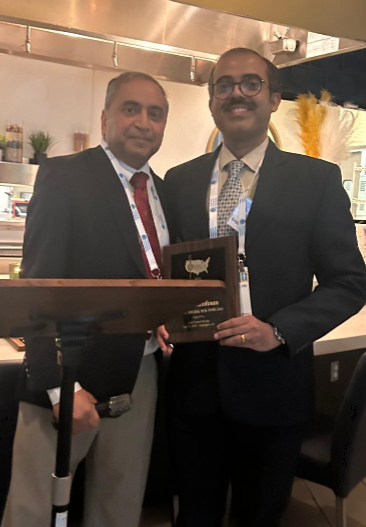
None of this experience would have been possible without the steadfast support of several individuals and the IAUA itself. I remain profoundly grateful to the association for creating the Satyendra Tewari Fellowship, an initiative that bridges continents and invests in the next generation of urologists. Special thanks are due to Dr. Ajay Singla, whose guidance in the months preceding my departure proved invaluable. His practical advice on logistics, expectations, and professional preparation helped ease the transition into an unfamiliar healthcare system. Upon arrival, Dr. Krishnan Venkatesan extended warm hospitality that went far beyond professional courtesy; his hosting created a sense of belonging that made Washington feel less distant from home. Equally important was the meticulous assistance of Olivia Ballmann, who navigated the official paperwork and administrative requirements with patience and efficiency, ensuring that every institutional clearance was in place. Their collective efforts transformed what could have been a purely clinical visit into a truly supported and enriching experience.
Beyond the operating rooms and conference halls, Washington, D.C., offered its own quiet lessons. In the intervals between clinical commitments, I explored many of the city’s iconic monuments and memorials—the Lincoln Memorial standing in quiet dignity, the Washington Monument piercing the sky, the reflective stillness of the National Mall, and the solemn beauty of the war memorials. Walking among these symbols of history and democracy provided moments of perspective. Medicine, after all, is practiced within the larger human story of progress, sacrifice, and shared aspiration. These visits grounded the intensity of surgical observation in a broader sense of purpose and reminded me of the privilege of learning in a place so rich with meaning.
Returning to India, I carry with me not only technical observations but a renewed commitment to excellence in robotic uro-oncology. The fellowship has sharpened my appreciation for meticulous preoperative planning, the value of team communication, and the continuous pursuit of refined technique. More importantly, it has strengthened my belief in the power of international exchange. Seeing how different institutions approach similar challenges—whether through variations in case volume, technology utilization, or teaching styles—has expanded my clinical toolkit and inspired me to integrate best practices into my own work.
In an era when medical knowledge advances rapidly and geographic boundaries matter less than shared purpose, programs such as the Satyendra Tewari Fellowship play a vital role. They enable young surgeons from different parts of the world to learn from one another, to build lasting professional relationships, and to return home better equipped to serve their patients. I am deeply thankful to the Indian American Urology Association for investing in this vision and for entrusting me with the opportunity.
As I resume practice, I do so with clearer eyes, greater humility, and a stronger sense of connection to the global urological community. The memories of operating-room observations, conversations with giants in the field, the kindness of mentors and hosts, and the quiet inspiration of Washington’s monuments will remain with me for years to come. This fellowship was more than a professional milestone; it was a transformative chapter that will continue to shape my approach to surgery and to the patients who place their trust in us.
I extend my sincere thanks once again to the IAUA, to Dr. Ajay Singla, Dr. Krishnan Venkatesan, Olivia Ballmann, and to all the faculty and staff at MedStar Washington Hospital Centre and Georgetown University Hospital who made this experience possible. May such bridges of learning continue to flourish for the benefit of urologists and the patients we serve worldwide.
–Dr. Midhun P. Gopalakrishnan (2026 Satyendra Tewari Fellow)